Form W-9 instructions, line by line
Everything the Rev. March 2024 form asks for, in the order it asks. Seven numbered lines and two parts, several of which you will leave blank. Use the contents list to jump to the line you are stuck on.
Have three things on hand: the exact name on your most recent tax return, your SSN or EIN, and the address you want your Form 1099 mailed to. If you are not sure whether your entity is a disregarded entity, read that page first. It decides Lines 1, 2, 3a and Part I all at once.
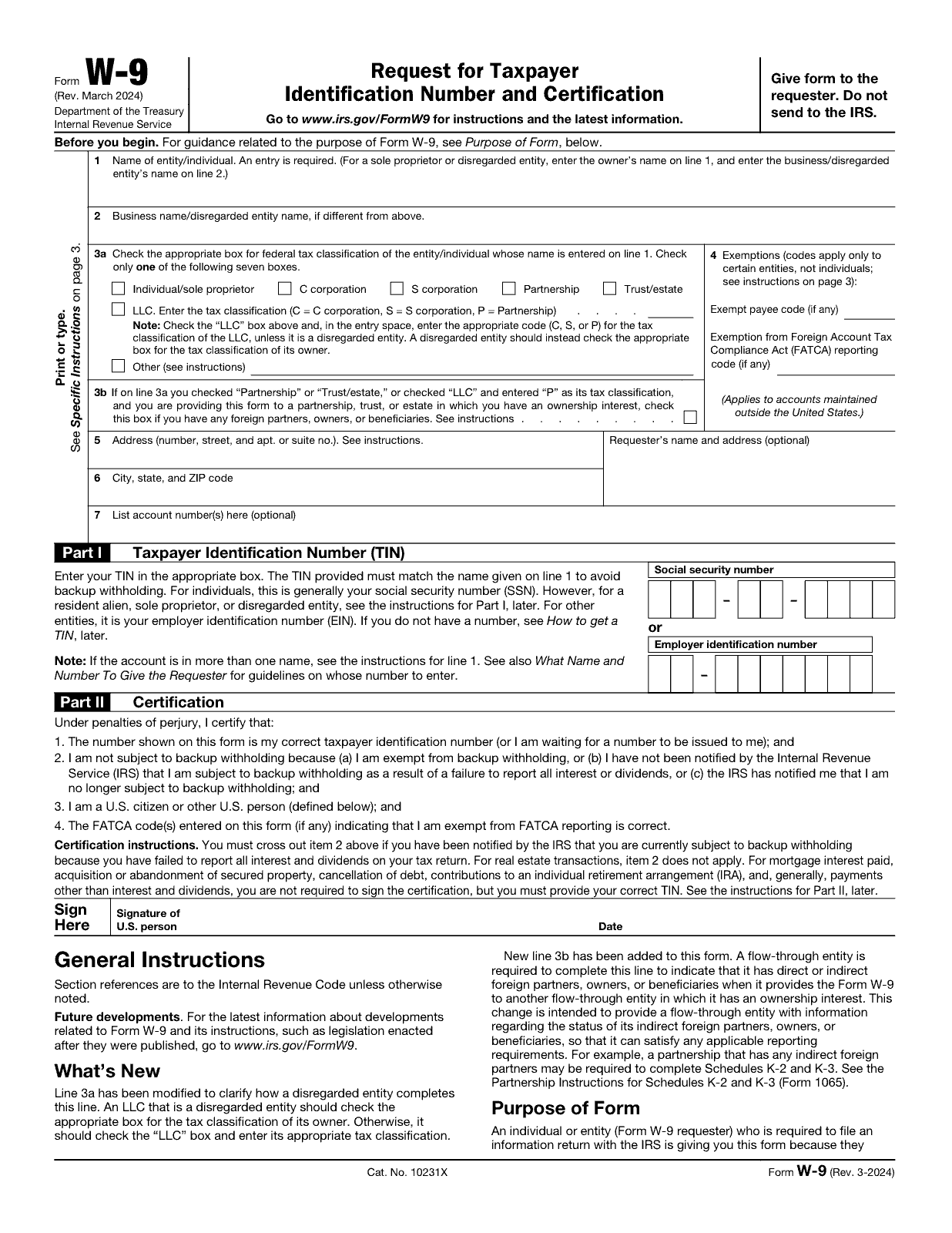
Line 1: Name of entity or individual
Line 1 must show the name that belongs to the taxpayer identification number you will enter in Part I. An entry is required. A W-9 with a blank Line 1 is invalid, and the requester should send it back. The name the IRS associates with your TIN is the name on your income tax return: for an individual, the name printed on the Social Security card; for an entity, the name on the EIN application or on the most recent return filed under that EIN. A nickname or a shortened first name is not that name, so write the full legal one even if nobody who pays you has ever used it.
| If you are a... | Line 1 shows | Line 2 shows |
|---|---|---|
| Individual or sole proprietor | Your own individual name | Your business name or DBA, if you have one |
| Single-member LLC (disregarded) | The owner’s name | The LLC’s legal name |
| Single-member LLC taxed as a corporation | The LLC’s legal name | Any trade name |
| Multi-member LLC | The LLC’s legal name | Any trade name |
| C or S corporation | The corporate name as registered | Any trade name or DBA |
| Partnership | The partnership’s legal name | Any trade name |
| Trust or estate | The name of the trust or estate | Any other name it operates under |
| Sole proprietor with an EIN | Your own individual name | Your business name |
If you write your business name on Line 1 but enter your Social Security number in Part I, the name and TIN will not match IRS records. The 1099 filed from that form generates a CP2100 notice to your client, a B notice to you, and eventually 24% backup withholding. The other twelve mistakes.
For a joint account, Line 1 shows the name of the person whose TIN you enter in Part I. For most joint accounts that is the first named holder, and you are asked to circle that name. Joint accounts in full. The IRS "What Name and Number To Give the Requester" table on page 5 of the form covers unusual cases: custodial accounts, sole proprietorships, grantor trusts and decedents’ estates.
Line 2: Business name or disregarded entity name
Leave Line 2 blank unless the name you trade under differs from Line 1. When it does differ, this is where the trade name goes:
- a DBA, trade name, fictitious name or assumed name;
- the legal name of a single-member LLC that is a disregarded entity, where the owner is on Line 1;
- a brand or product name a corporation invoices under;
- a division name, where the payer knows you by the division rather than the parent company.
Nothing you write on Line 2 affects which TIN you use or how you are taxed. The line exists so the payer can reconcile the W-9 against the name on your invoices, and so the 1099 that eventually arrives does not look like it belongs to a stranger.
Line 3a: Federal tax classification
Check exactly one of the seven boxes, and check it for the entity or individual named on Line 1. The classification follows that name rather than anything you wrote on Line 2.
C, S or P in the space to show how it is taxed. Which letterA single-member LLC that has made no election is a disregarded entity, so it checks box 1 and reports the owner instead of using the LLC box at all. Checking the LLC box and then leaving the letter space empty is the second most common error on the form. The full walkthrough.
An election you filed changes the answer here, so if you sent in a Form 8832 or a Form 2553 and are not certain it took effect, confirm the classification before you commit to a box. There is detailed guidance on choosing a Line 3a box, including what to do after an entity classification election on Form 8832 or an S election on Form 2553.
Line 3b: Foreign partners, owners or beneficiaries
Almost nobody checks this box. Do it only if all three of the following are true:
- on Line 3a you checked Partnership or Trust/estate, or checked LLC and entered
P; and - you are giving this form to a partnership, trust or estate in which you hold an ownership interest; and
- you have any direct or indirect foreign partners, owners or beneficiaries.
The line was added in the March 2024 revision so that an upper-tier flow-through entity learns that foreign persons sit somewhere beneath it and can meet its own withholding and reporting obligations. The three conditions stack, so failing any one of them takes you out of the line entirely, and the second is the one that eliminates most people: the form has to be going to a partnership, trust or estate in which you hold an interest, and a client who merely pays your invoices does not qualify. In practice the box belongs to tiered structures: your partnership holds an interest in another partnership, and a foreign person sits somewhere in your own ownership chain. If nothing sits above you, the line has nothing to say. If you are an individual, a corporation, or a partnership handing a W-9 to an ordinary business customer, leave Line 3b blank. Full explanation with examples.
Line 4: Exemptions
Two small boxes sit on Line 4, and most filers leave both of them empty. The codes exist for organizations and financial institutions with a statutory basis for claiming an exemption. If you cannot point to the provision that covers you, the box is not yours to fill. The table below shows what each box claims and who actually has a use for it.
| Box | What it claims | Values | Who uses it |
|---|---|---|---|
| Exempt payee code | Exemption from backup withholding on certain payment types | 1 to 13 | Tax-exempt organizations, government bodies, corporations on some payment types, REITs, banks, registered dealers. All thirteen codes |
| FATCA exemption code | Exemption from FATCA reporting, and only for accounts maintained outside the United States | A to M | The same broad classes of institutional payee. If your account is held in the U.S., this box is irrelevant. All thirteen codes |
An individual, sole proprietor or single-member LLC has no exempt payee code and no FATCA code. Entering one is a false certification. Being exempt from backup withholding is a different thing from being exempt from tax, and different again from keeping your payments off a 1099 altogether.
Lines 5 and 6: Address
These two lines tell the requester where to mail information returns. Line 5 takes the street, number and suite; Line 6 takes city, state and ZIP.
- Use the address you want your Form 1099 to arrive at, which may not be your legal or registered address.
- A PO box is acceptable if that is where you reliably receive mail.
- If you have moved since your last return, use the current address. IRS matching runs on name and TIN, so a new address will not cause a mismatch.
- A registered agent address works for an entity, provided the agent forwards mail promptly.
There is also an optional space on the right for the requester’s name and address. Nothing depends on it. Fill it in anyway if you send out many W-9s, because it is the only record on the form itself of who is holding a copy of your TIN.
Line 7: Account numbers
Line 7 is optional, and it earns its keep only in one situation: a bank, brokerage or platform holds several accounts under your name and needs to know which of them this certification covers. List the account number or numbers the form relates to. For a straightforward contractor relationship, leave the line blank, or put in the vendor number if the client asked for one.
Part I: Taxpayer identification number
Enter a number in one box, and make sure it belongs to the name you put on Line 1. Which box you use follows from who Line 1 names. A sole proprietor holding both an SSN and an EIN has a real choice to make here; almost nobody else does.
| Your situation | Number to enter |
|---|---|
| Individual or sole proprietor with no EIN | Your SSN |
| Sole proprietor with an EIN | Either your SSN or your EIN. The IRS prefers your SSN, because Line 1 shows your individual name |
| Resident alien without an SSN | Your ITIN |
| Single-member LLC, disregarded | The owner’s SSN or EIN, and never the LLC’s own EIN |
| LLC taxed as a corporation or partnership | The LLC’s EIN |
| Corporation, partnership, trust or estate | The entity’s EIN |
| Applied for a TIN but not received it | Write “Applied For” in the space and sign. The 60-day grace period covers interest, dividends and certain readily tradable instruments only; for other payments withholding applies until the number arrives |
The form says this in bold: Do not enter the employer identification number of a disregarded entity. A single-member LLC may hold an EIN for payroll or banking, but for W-9 purposes the number is the owner’s. Why this rule exists.
SSN, EIN and ITIN compared, including how to get one and what to do while you wait.
Part II: Certification
Sign and date. Four separate statements ride on that signature, all of them made under penalties of perjury.
If the IRS has notified you that you are currently subject to backup withholding for under-reporting interest or dividends, you must cross out item 2 before signing. That situation reaches only interest, dividends and broker transactions. For ordinary contractor payments, leave the certification intact. The certifications in detail.
The form sets this out explicitly, and it surprises people: for ordinary business payments the certification signature is not mandatory. A correct TIN is mandatory every time.
| Account or payment type | Must you sign? |
|---|---|
| Interest, dividend and barter exchange accounts opened before 1984, and broker accounts active during 1983 | Give your correct TIN. No signature required |
| Interest, dividend, broker and barter exchange accounts opened after 1983 | You must sign, or backup withholding applies |
| Real estate transactions | You must sign. You may cross out item 2 |
| Other payments: rents, royalties, goods, medical and health care, nonemployee services, card and network settlements, gross proceeds to attorneys | Give your correct TIN. No signature required, unless you have been notified that you previously gave an incorrect TIN |
| Mortgage interest you paid, acquisition or abandonment of secured property, cancellation of debt, IRA contributions | Give your correct TIN. No signature required |
For ordinary contractor payments the form does not strictly require your signature, only your correct TIN. Requesters are under no obligation to accept an unsigned form, though. Most reject one on sight, and an unsigned W-9 is the single most common reason a form comes back, so sign it and save yourself the round trip.
A completed example
A freelance designer named Jordan Alvarez trades as Alvarez Studio, an Ohio single-member LLC with no tax elections, and here is every entry on the form, top to bottom.
Other entity types change only Lines 1, 2, 3a and Part I. Pick your situation: sole proprietor, single-member LLC, multi-member LLC, S corporation, C corporation, partnership, nonprofit, trust or estate.
Final checks before you send it
- Line 1 name matches the name attached to the TIN in Part I.
- Exactly one box is checked on Line 3a: not none, not two.
- The LLC box, if checked, has C, S or P written in the space.
- Line 4 is blank unless you are genuinely an exempt entity.
- Part I has a number in one box only, with the right number of digits.
- Part II is signed by hand or with a valid electronic signature, and dated.
- You kept a dated copy, and you are sending it through a channel the requester controls.
General information, not tax advice. This page explains a federal tax form in plain English. It is not legal, tax, or accounting advice, and W9Form.org is not affiliated with the IRS. Verify everything against the official Form W-9 page on IRS.gov and speak to a licensed professional about your own situation. How we source and review these pages.